
Extra festive. Extra cute.
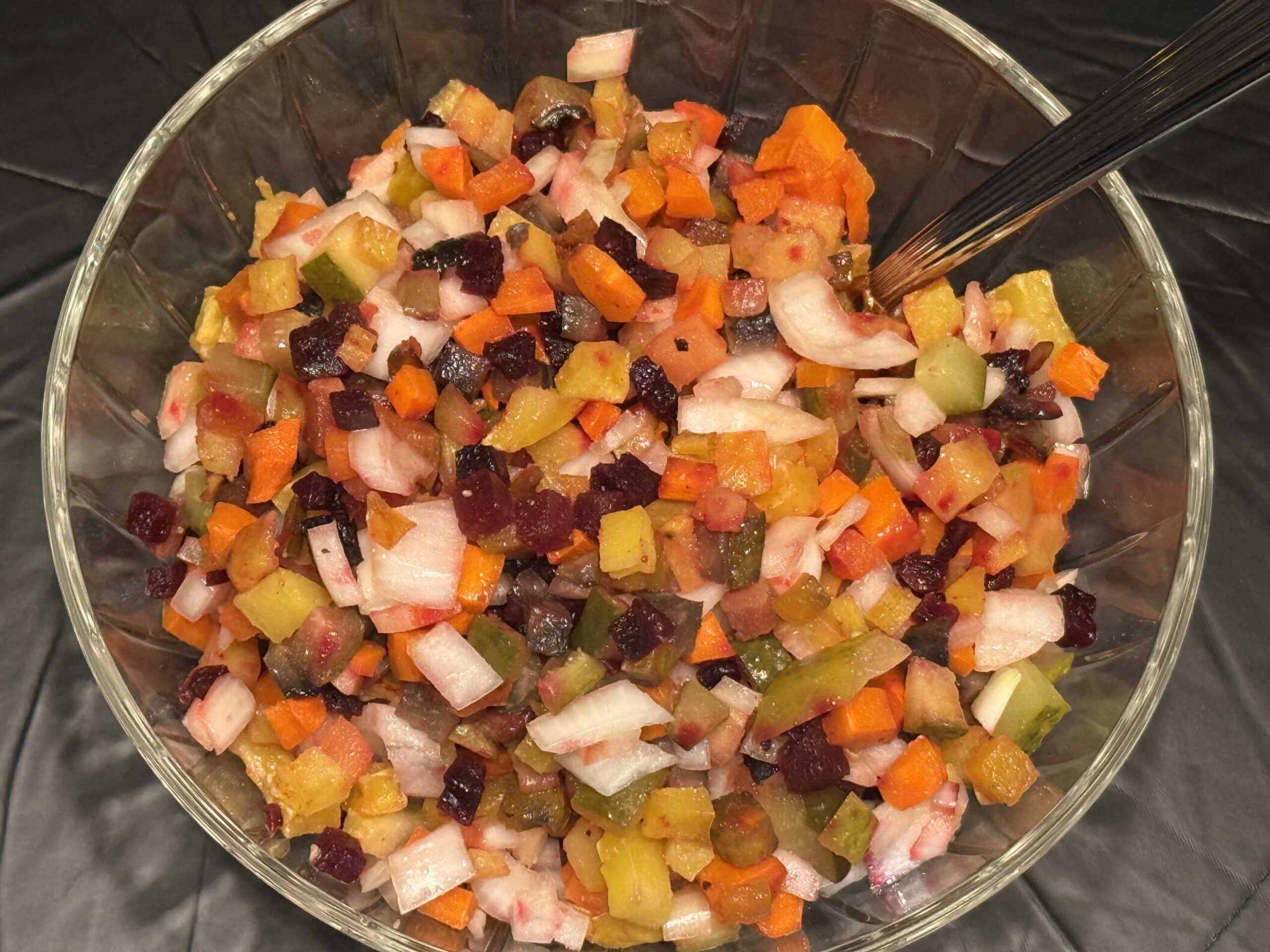
I call it Christmas Sweater because of the color scheme and general look of the dish, but this recipe is not tied or limited to the holidays. Earthy, sour, sweet and rich, it’s tasty in any context.
It’s true that if you bring this dish to a holiday potluck whilst adorned in your own Christmas sweater you will totally rule, but it also works as a hearty main vegetable dish or side. And its sweet acidity also makes Christmas Sweater almost condiment-like. I once overheard it referred to, enthusiastically, as “that relish thing” at a gathering, a name that captures its versatile utility. And based on how it looks it could just as accurately be called “Box of Jewels.” Whatever you call it and however you use it, this is, above all else, a winter dish. A hearty dish. And if prepared properly, a cute dish, according to the Belarusian farmers at the winter market who gave me the recipe.
The Lemezas are beetnicks to the core. Their rosy cheeks betray their beet-red blood, even when winter is trying its hardest to give us the blues. Even when they have nothing else to sell but beets, they are smiling because they have beets, large as softballs and dense as gold.
Mr. Lemeza’s personal favorite way to eat beets is shredded raw with Italian dressing; he pinched his fingers in front of puckered lips for emphasis when he shared this with me. Then he leaned in conspiratorially to gift me the recipe that we all have come to know as Christmas Sweater.
His callused welder fingers counted off a list of ingredients: “Beets, carrots, potatoes – cooked,” he said, looking me in the eye with intensity. “Chopped onions, pickles, salt, little bit of oil.”
“Cut small,” added Mrs. Lemeza, beneath a long red parka that matched their cheeks.
“3/8-inch,” he said, holding two fingers together so close you could barely see through them.
“So it’s cute,” she added.
At the time they referred to it as beet vinaigrette, which caught me off guard at first, because normally vinaigrette contains, you know, vinegar. And then I realized that the vinegar in their vinaigrette comes from chopped pickles, which like beets are serious business back home in Olshany, Belarus. Wowed by the brilliance of using pickles as the acid in a salad, I quickly found all of the principle ingredients at the market, and skipped home to play with my food.
I made the recipe a few times that week, my confidence growing with each rendition. At the following market I brought a sample of my latest and greatest batch, Mr. Lemeza’s eyes flickering back and forth between the dish and its maker with skepticism.
“It’s too big,” he said, poking at the pieces with the spoon I’d provided. Indeed, my chunks were more like 5/8-inch, not the directed 3/8. I hadn’t realized it was such a big deal. Finally he took a bite.
“The taste is good,” he acknowledged, sounding surprised to hear himself say it. Mrs. Lemeza took a bite and concurred. “But it has to be more cute,” she pleaded, rolling the “r” in “more.”
“It’s too ugly?” I confirmed.
“Yes,” she said, laughing. At least they loved the name Christmas Sweater, which they still call it to this day.
When I make it at home I must admit, my Christmas Sweater is still kinda ugly. Sad but true. It’s just as delicious and satisfying and nourishing as it is with cute chunks, which I suppose reflects my priorities. But when I bring out my Christmas Sweater into mixed company, you can be sure it’s the cutest thing you have ever seen. After all, if it’s an option, why not rule the potluck?
Christmas Sweater
Your go-to recipe for any deliciously awkward wintertime occasion, or a cozy night in. When I say “diced” I mean perfectly adorable 3/8 inch cubes.
Serves 4-8 as a side, 2-4 as a main
1 pound potatoes, peeled
1 pound beets, peeled
1 pound carrots, peeled
1 medium onion
2 cups diced dill pickles
½ cup olive oil
Salt and pepper, to taste
Preheat the oven to 350, and peel and cube the veggies as perfectly as possible. Do the beets last, as you will need to wash the cutting board immediately.
Whether it’s an onion, potato, pickle, carrot or beet, the concept of dicing is always the same. Make as few cuts as possible to slice the object in all three dimensions. Start by cutting it in half, lengthwise, and lay the flat sides down (carrots you can cut down to four-inch lengths). Slicing straight down, cut off the tops and bottoms, then turn the knife 90 degrees and make a series of parallel cuts about ¼-inch apart along the top-to-bottom axes. Turn each newly-sliced half 90 degrees, and make another series of crisp, ¼-inch cuts.
The next part is tricky because it wants to fall apart. Try to pull apart each twice-sliced half, like “cutting” a deck of cards, and roll sideways onto the cutting board, so you have flat sides down again and can cut the long cubic rectangles into perfect cubes.
Bake all of the cubed veggies in separate dishes, stirring occasionally to check on the moisture levels and let the pieces cook and dry evenly. Add half of the olive oil to the potatoes before cooking them, so they don’t stick together. When each type of veggie is soft and dry but not browned, remove from the oven and allow them to cool to room temperature.
Add the rest of the olive oil to the beets, which seals in the beet color and prevents it from bleeding onto the rest of the salad.
When everything is cool, cubed and cute, gently toss everything together, minus the beets and onions. Season with salt, pepper and garlic powder. Then stir in the beets, and finally the lily white onions, added last to keep them as unstained as possible. Taste, adjust seasonings, and serve.