
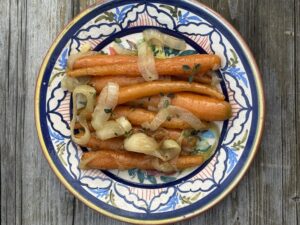
If given the choice, most omnivores and non-rabbits would choose meat over carrots. This is nothing to be ashamed of if you identify as an orange taproot. It’s just that we humans have been evolutionarily programmed to seek out the captivating savory umami flavor of flesh, and the protein content it signifies. The carrot, meanwhile, though sweet and mildly fragrant, delivers a less seductive dose of fiber, and tastes vaguely of dirt.
Given this reality, I have been surprised to notice a proliferation of simple carrot dishes on the menus of some decidedly meat-focused restaurants. These plates are usually in the form of simple sides that, despite the competition, can sometimes steal the show.
My first encounter with this phenomenon happened at a Missoula steakhouse called 1889, in the form of an order of poached new carrots, about five inches in length, plated in parallel fashion. This dish, called The Carrots, arrived alongside a well-marbled chunk of wagyu. The Carrots were tender, simply seasoned, and so rich that the steak got a little cold as my kids and I devoured them, all of us eating defensively to ensure we each got our fair share of this scarce resource.
Soon after I found myself at a similarly meaty establishment, Jesse Pepper’s Smokehouse in White Sulphur Springs, where a similar dish went by the name “Mom’s Carrots.” It was a rainbow assortment, rather than a plate of straight orange spears, but the motif was similar: a plate of new carrots, cooked simply. And once again the carrots outshone the meat — brisket, in this case.
I never inquired as to how either dish was created. But I did some research and repaired to my lab, where I set about trying to reverse engineer these carrot-based dishes.
In my first attempt, I slow poached baby carrots from the farmers market in a blend of butter, olive oil and wagyu tallow from a large tin I keep in the fridge. I added some neon cloves of fresh garlic, slices of onion, fresh rosemary and thyme, slices of lemon peel, and salt and pepper.
My son, who is as close to the polar opposite of an herbivore to ever walk this planet, declared my carrots the most delicious thing he’d ever consumed. Hyperbole? Sure, but the sentiment hit the mark nonetheless. And that meal was just the beginning. It seems I had stumbled upon more than a carrot recipe, but a way of life. Because while the carrots themselves only existed undigested for a brief moment, the poaching liquid went on to lead a glamorous afterlife.
The next day, I used some of the leftover poaching oil to pan fry some some steamed potatoes, along with a dash of whole cumin seeds stirred in. They developed a glorious crisp, and a deeply satisfying rich flavor. I served those potatoes alongside a salmon filet that I’d sauced with a mix of white miso, lemon juice, and more of the carrot poaching fat. I made the sauce by first sautéing some fresh garlic, in leftover carrot poaching fat, of course. When the garlic hit max fragrance, I added the miso mixture and turned off the heat. I rubbed this sauce on the salmon and cooked it slowly.
I was fully committed to this fat poached carrot lifestyle when my other son suggested, blasphemously, that the carrots were too rich for his taste. So I came up with a lighter version of the recipe. I added about an inch of water to a pan, along with the carrots, herbs, lemon peal and salt and pepper, and only two tablespoons of olive oil. I cooked the carrots on medium heat with a tight lid, and when they were tender I took off the lid and allowed the water to evaporate, leaving only the oil and seasonings in the pan. I let the carrots cook a wee bit longer, so they could get a little crispy in the oil, and served them to the leaner son. He was pleased.
About a week later I ran into my farmer friend Luci, and told her about my breakthroughs. As a carrot grower, I figured she would be interested in my research. She took a step back and looked at me like I was crazy. It turns out that Luci is such the practical sort that harvesting baby carrots makes no sense to her. She lets them grow bigger, so that there will be more carrot to sell, or to enjoy — grated into salad, or dipped into hummus, or braised into her famous carrot pasta sauce.
But something didn’t add up. “Don’t you thin your carrot rows,” I asked. Indeed she did, she said. I thought I had her cornered. Going in for the kill, I asked, “What do you do with the little carrots you pull when you thin the rows?”
“We stuff them into jars of leftover pickle juice.”